







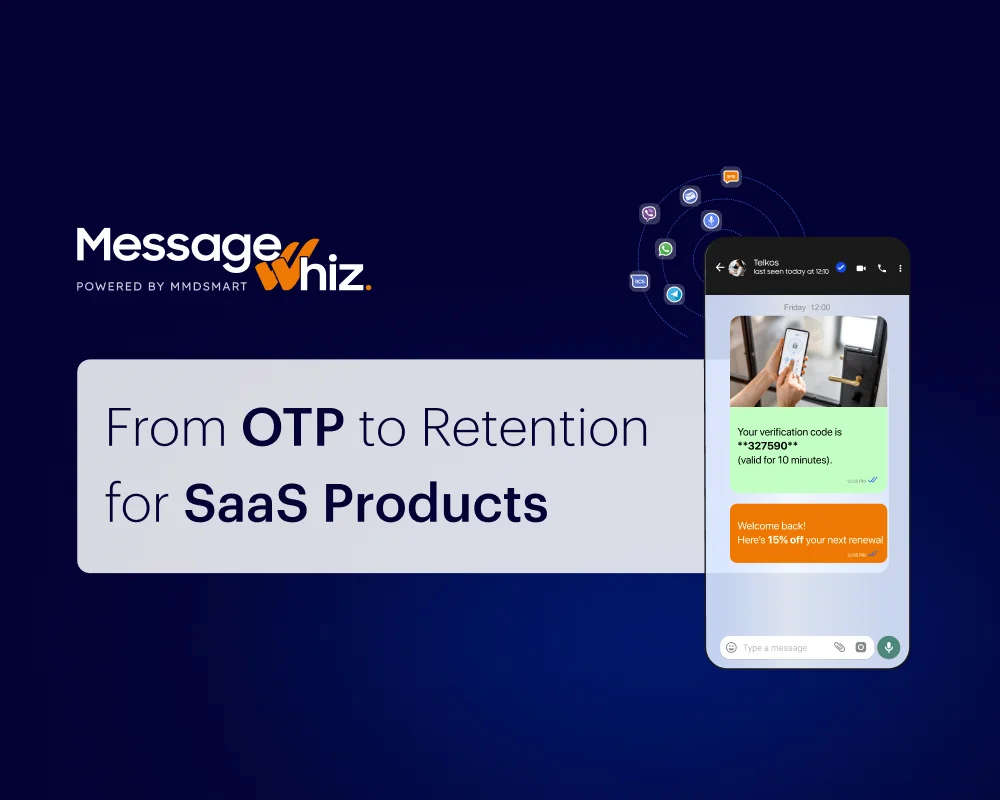
Messaging automation for SaaS product companies can start and end with One Time Passwords – OTP. But it shouldn’t be.
A user signs up, receives a verification code, and confirms their account. Then the communication layer goes quiet or shifts to email. In many cases there is no behavioral trigger when they haven’t completed setup. No check-in when they go three days without returning. No multi-channel follow-up before the trial expires.
That silence is costing you users you already paid to acquire.
The pattern is consistent across many of the verticals that we monitor: teams configure verification at launch, add a welcome email sequence, and treat the messaging layer as finished. Meanwhile, users who never reach a first meaningful outcome churn without a word, and the acquisition spend that brought them to signup generates nothing.
According to the 2026 State of Digital Customer Communication Survey, a study of 300 senior marketing, product, and operations leaders, 99 percent of organizations use messaging for notifications, alerts, and customer service. Only 53 percent use messaging for growth activities like promotions and retention.
The operational usage of messaging is near-universal, but using messaging as a tool to retain and grow customers is not.
Messaging automation for SaaS products is the practice of using programmable, multi-channel communication to reach users at each stage of their lifecycle based on what they actually do in your product, rather than on a fixed schedule. The channels that carry that communication include SMS, WhatsApp, Viber, and RCS – some are using Telegram as well. The goal is to close the gap between account creation and genuine product adoption, then sustain PLG – Product Led Growth, with engagement, expansion, and renewal.
Why is OTP the most critical first message your product sends?
The verification code you send at signup is not just a security step. OTP is the first communication your product delivers to your potential customer, and delivery failures at this stage can drive user abandonment even before they have actually experienced your product or service.
Three mechanics that determine OTP success include:
- Delivery speed: Users expect the code within seconds. Delays above 10–15 seconds measurably increase abandonment
- Global carrier routing: Direct carrier connections reduce the failure rates that come from routing through intermediaries
- Fallback logic: When an SMS OTP fails to arrive, a well-configured system retries automatically via voice or an alternative channel without requiring the user to take any action
Building a fallback infrastructure from scratch can take engineering time that most SaaS product teams have no interest in spending, as feature priorities are usually higher.
Reliable and timely OTP delivery is the foundation everything else rests on. If users cannot get through account creation, no other messaging touchpoint in the lifecycle ever fires. NIST SP 800-63B, the federal standard for digital identity, classifies SMS OTP as a valid authenticator and outlines the risk mitigation requirements that a compliant implementation needs to satisfy.
How can messaging automation for SaaS products improve onboarding completion rates – it’s not with email?
According to Pendo’s 2025 global benchmark data, software products retain only 39 percent of users after one month. Six in 10 new users are gone within 30 days. Early drop-off is disproportionately high in the first days after signup, which makes the initial communication layer critical.
Email-based onboarding sequences are the default approach for most teams, yet HubSpot’s 2025 email marketing benchmarks put the average open rate for SaaS product emails at 38 percent. HubSpot notes that even that figure is significantly inflated by Apple Mail Privacy Protection, which pre-loads emails automatically regardless of whether a user actually reads them. An SMS or an interactive WhatsApp message with embedded next-step buttons reaches a user faster and more directly than any inbox.
According to Salesforce’s State of Marketing report, 83 percent of marketers recognize the shift toward personalized, two-way messaging. Only one in four, however, say they are satisfied with how they use data to power those moments. Behavioral triggers are what close that gap. When your messaging layer connects to your product’s event data, each message fires based on what a user actually did or did not do. Consider what this looks like in practice:
- Signup complete, profile not finished: An SMS or WhatsApp message fires with a direct link to the next setup step, sent within the hour
- Profile set up, no team members invited: A follow-up message triggers 24 hours later with a prompt and a one-tap invite link
- Three days inactive after setup: A re-engagement SMS fires with a short prompt referencing where the user left off
Each message responds to real behavior rather than running on a timer that fires regardless of where each user actually is in the flow. The difference in onboarding completion rates between time-based and behavior-based messaging is significant, and it widens as your user base grows.
The business case for expanding beyond email is clear: among organizations that recently added a new messaging channel, 86 percent reported increased customer engagement, according to the 2026 State of Digital Customer Communication Survey.
What’s the most effective way to follow up with free trial users?
The 72 hours before a free trial ends are the highest-leverage window in your entire conversion funnel. Most SaaS product companies send one email in that window. A meaningful share of trial users never open it.
A multi-channel approach gives you additional opportunities to reach those users before the clock runs out. An interactive WhatsApp message sent 48 hours before expiry, with a button to extend the trial or move to a paid plan, reaches users that email misses. An SMS sent the day before expiry functions as a final touchpoint on a channel with near-universal open rates.
Both messages can be personalized based on each user’s actual activity during the trial. A user who activated multiple features and logged in frequently receives a different message from someone who signed up and visited once. Segmenting on their history in your product makes the message feel like a relevant prompt rather than a generic push. Users in the first group respond well to capability-focused messaging. Users in the second group often need a re-engagement nudge or an offer of help before they are ready to convert.
How does messaging reduce SaaS product churn after conversion?
Most SaaS product retention messaging concentrates on the renewal window, but churn risk builds much earlier. Users who lose momentum in the second or third week after conversion are unlikely to renew regardless of what they receive at month eleven. Harvard Business Review research puts the business case plainly: a 5 percent increase in customer retention rates can translate into a 25 to 95 percent increase in profits. The communication you invest in after conversion is where that 5 percent is won or lost.
Usage-based triggers give you low-friction, non-intrusive reasons to reach users throughout the subscription period:
- 14-day inactivity: A re-engagement message fires on the channel where that user has historically been most responsive
- Key action completed: A one-question satisfaction check arrives via SMS or an interactive WhatsApp message. It takes seconds for customers to answer and gives you an early signal on retention risk
- Feature not yet discovered: A timely prompt highlights a capability the user has not yet tried, based on their usage pattern
Consistent, well-timed touchpoints across the subscription period maintain the kind of engagement that a single renewal reminder cannot replicate on its own.
Which channels should SaaS product companies use for each lifecycle stage?
| Channel | Best for | Reach | Key capabilities |
| SMS | OTP, urgent alerts, re-engagement | Global | Open rates above 90%, no app required, 2FA |
| Onboarding flows, trial nurture, satisfaction checks | 2B+ users globally | Interactive messages, buttons, rich media | |
| Viber | Eastern Europe, Southeast Asia | 1B+ users | Rich messages, buttons, branded sender |
| RCS | Enhanced transactional messaging | Rapidly expanding | Verified sender, rich cards, suggested replies |
No single channel covers every user and every use case in every market. A SaaS product company with a global user base needs to route each message to the channel most likely to reach that user and fall back gracefully when the primary channel fails. It is a very acceptable decision to select SMS only. Although it does not support rich media, it is an extremely reliable, global messaging channel.
Can you integrate messaging into your existing tech stack?
Yes. MMDSmart MessageWhiz can connect to your product, your CRM, AI agents, or other management systems via a robust easy-to-use API, so messages fire directly from the events that you define. Your engineering team integrates once, and from there your product or growth team controls the trigger logic without a separate campaign tool or a manual send process.
Can a small SaaS product team get the same messaging support as an enterprise?
With MMDSmart MessageWhiz, SaaS product companies of all sizes receive the same 24/7 support and customization help. Your dedicated account manager can advise on messaging strategy and help support you with any technical issues. This approach enables small and medium sized SaaS developers to maintain and automate communication with their customers.
FAQ
Does messaging automation replace email for SaaS product companies?
Messaging works best alongside email, not instead of it. Email handles long-form content such as release notes, invoices, and detailed documentation. SMS and WhatsApp handle time-sensitive triggers, including OTP, trial expiry reminders, and re-engagement nudges where open rate and response speed determine whether the message lands or not. The combination consistently outperforms either channel on its own.
Which messaging channel works best for SaaS product onboarding?
WhatsApp tends to perform best for guided onboarding flows because interactive messages let you include action buttons, links, and media alongside the text. Users get a clear next step without having to open a separate browser tab or navigate away from what they were doing. SMS works as the right fallback for markets or users where WhatsApp is not available.
How difficult is it to switch from Twilio to a different messaging API?
For most SaaS product teams, migration is manageable if messaging logic sits behind your own service layer. You update the API credentials and adjust the endpoint calls. The primary work is testing delivery across your target markets, which any provider change requires. From what we’ve seen, most teams complete the switch in under two weeks.
Is automated messaging compliant with GDPR and similar data privacy regulations? Automated messaging can be fully compliant provided users have given consent to receive messages and opt-out requests are processed promptly. A messaging platform that manages unsubscribe lists automatically and logs consent at the point of collection handles the compliance layer so your team does not need to build and maintain that logic independently.
How do you measure whether messaging is improving SaaS product retention?
Start by tracking three metrics for each message type:
- Delivery rate: Confirms the message is actually reaching the user
- Open rate: Confirms the channel and timing are working
- Click-through rate: Confirms the message is compelling enough to act on
Then correlate message receipt with downstream user behavior in cohorts: do users who received a Day 7 re-engagement message log back in at a higher rate than users in the same signup cohort who did not? That cohort comparison, tracked consistently, tells you which messages are moving retention metrics and which ones you can cut.
How do you build a messaging layer that works across every customer stage?
Keeping users engaged from verification to renewal is not a product problem alone. The communication layer around your product determines whether users stay or leave long before any renewal conversation begins. Message reliability, behavioral relevance, and channel consistency each shape the relationship your product has with the people using it.
MMDSmart MessageWhiz gives SaaS product teams a single messaging layer for the entire customer journey, customized based on your needs. From the OTP at account creation to the retention touchpoint that protects renewal twelve months later, we have you covered. If your messaging layer currently stops at OTP, talk to us. We can map the full lifecycle automation in a single session.