








When a customer taps “Confirm My Reservation,” they expect a code to land on their phone within seconds. If that code takes even 10 seconds too long, or never shows up at all, you haven’t just lost a text message. You’ve lost the moment, and possibly the customer.
Why do one-time passwords matter beyond security?
Most people think of a one-time password as a login safeguard, something that protects a bank account or a healthcare portal. That’s true, but it’s only part of the picture. Today, an OTP, whether it’s via SMS or WhatsApp, might confirm a restaurant reservation, verify a food delivery order, secure a ride booking, or authenticate a ticket purchase before a sold-out show. OTP notifications aren’t just about security authentication but their speed and delivery accuracy are relevant for your customer’s experience.
A slow OTP on a banking app will probably frustrate your customers. A slow OTP on a Friday night reservation, when a customer is standing at the door of your restaurant or trying to lock in a table before someone else does, can end the transaction entirely. They can close the tab, call a competitor, or simply give up.
What happens when an OTP arrives late?
When a verification code lags, whether it’s coming from your booking system, your ordering platform, or another customer-facing tool, the failure shows up as a business problem, not just a technical one. Abandoned bookings. Abandoned carts. A customer who assumes your platform is unreliable, even if the fault sits with a routing path, several steps removed from your brand.
For businesses running high-volume, time-sensitive traffic, hospitality venues, ticketing platforms, delivery services, and ride-hailing apps, the OTP has to work fast, every time, not most of the time.
How does routing intelligence affect OTP Speed?
The difference between an OTP that arrives instantly and one that stalls usually comes down to routing. A message can take a slow, unreliable path to the recipient’s carrier. MMDSmart MessageWhiz addresses this with global routing intelligence that finds the fastest, most reliable path for every OTP notification, on every send, based on real-time network conditions rather than a fixed route. Codes can also be encrypted end to end, which helps guard against interception and spoofing on top of the delivery speed itself.
That combination, encrypted delivery paired with intelligent routing, is what lets a business treat OTP as infrastructure it can build a customer experience on, rather than a step it has to cross its fingers over.
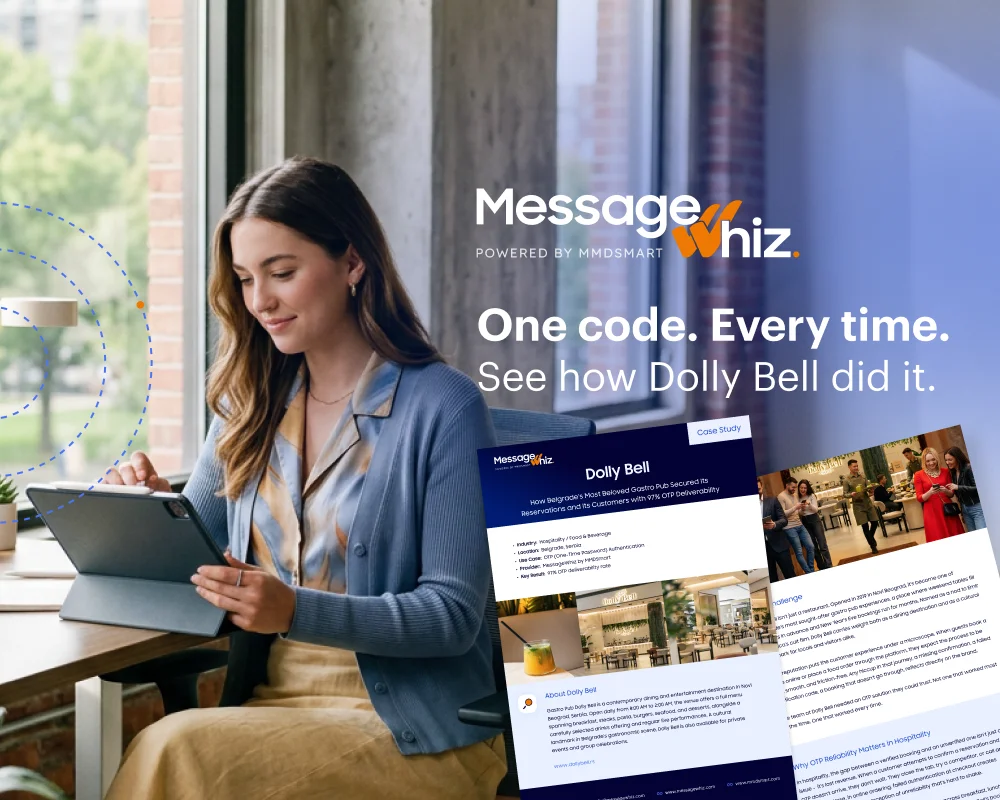
See how Dolly Bell gastro pub improved their reservation and ordering confirmations
Dolly Bell, one of Belgrade’s most in-demand gastro pubs, needed an OTP solution that could keep pace with reservations and orders coming in from breakfast through late night, every single day. The case study walks through how MMDSmart MessageWhiz helped Dolly Bell reach a 97% OTP deliverability rate across its booking and ordering flows, and what that reliability meant for a venue where a failed verification could mean an empty table on a Saturday night.
If you want to see what dependable OTP delivery looks like in a real, high-traffic hospitality business, download the Dolly Bell case study and see the results for yourself.
Download the Dolly Bell Case Study
FAQ: One-Time Passwords for Customer-Facing Businesses
What is an OTP used for besides login security?
An OTP can confirm a restaurant reservation, verify a food delivery order, secure a ride booking, or authenticate a ticket purchase before a sold-out show. In each of these cases, the code protects an experience your customer has already chosen, not just an account.
Why does OTP delivery speed matter for hospitality and booking platforms?
When a customer is standing at your door or trying to lock in a table before someone else does, a delayed code can end the transaction. They may close the tab, call a competitor, or abandon the booking entirely, even when the delay has nothing to do with your platform itself.
What causes an OTP to arrive late?
A message can be sent immediately and still take a slow or unreliable path to the recipient’s carrier. The delay usually comes down to routing, not the moment the code was triggered on your end.
How does MMDSmart MessageWhiz improve OTP deliverability?
MMDSmart MessageWhiz uses global routing intelligence to find the fastest, most reliable path for every code on every send, based on real-time network conditions rather than a fixed route. Codes can also be encrypted end to end to help guard against interception and spoofing.
What OTP verification channel should you use for time-sensitive transactions?
SMS remains the most reliable choice for OTP verification because it does not depend on an app being installed or a data connection being active. Whether the code originates from your booking system, your CRM, AI agents, or other management systems, SMS delivery through a platform like MMDSmart MessageWhiz gives you a channel your customer can act on the moment it arrives.