







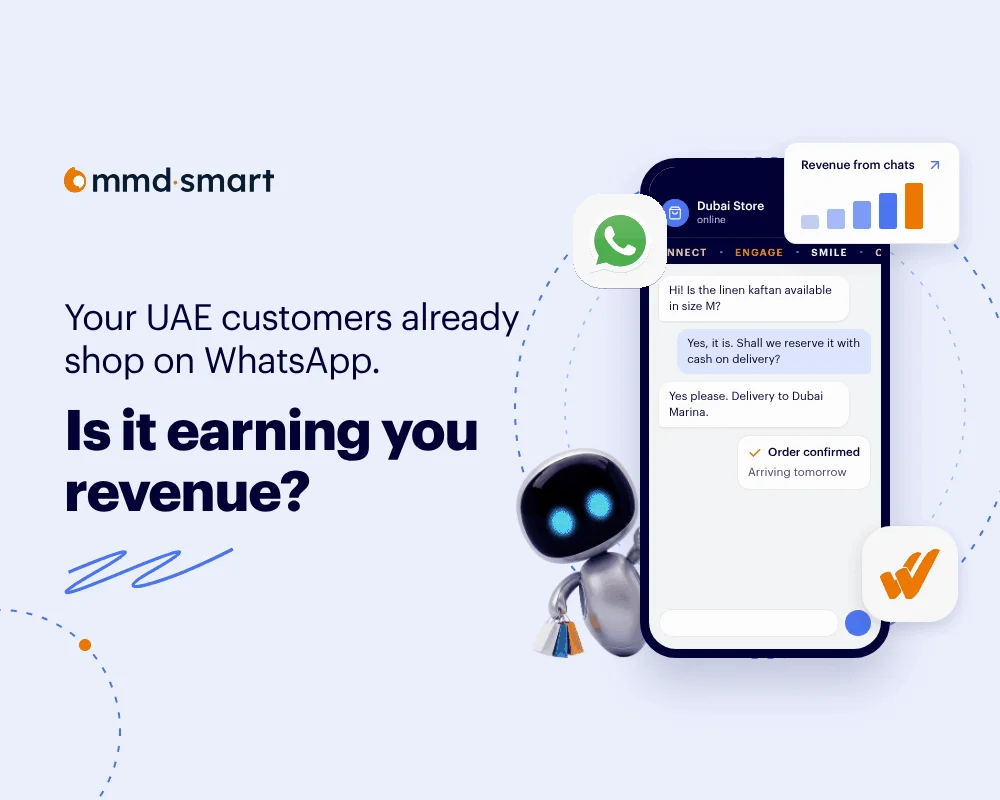


Your customers in the UAE already shop on WhatsApp. They ask about sizes, confirm cash-on-delivery orders, and check delivery times in the same app they use to talk to family. Many sales and marketing teams still view the channel as a support inbox, though, and report on tickets closed rather than revenue earned.
Running WhatsApp as a support inbox became more expensive on October 1, 2026. Meta now charges for service messages beyond the first 1,000 delivered per business number each month, so conversations past the free tier carry a cost. WhatsApp marketing in the UAE has to show what it returns. Once you can measure that return, WhatsApp stops being a support expense and becomes a line on your P&L that you can justify growing.
Why is WhatsApp the leading sales channel in the UAE and GCC?
WhatsApp is where UAE customers already spend their time, so a WhatsApp sales program builds on existing habits. You don’t have to ask customers to download an app, visit a portal, or switch channels. DataReportal’s Digital 2027 UAE report found that 84.1% of internet users aged 16 and over used WhatsApp in the past month, making it the most-used platform in the country.
Three regional conditions make WhatsApp especially effective for sales:
- Established customer habits: Customers already message businesses on WhatsApp, so you can reach them on a channel they know and trust.
- Cash-on-delivery friction: COD remains common across the region, and an unconfirmed order can easily become a failed delivery. A short two-way exchange can resolve the problem before the order ships.
- Bilingual expectations: Customers expect templates, chatbot flows, and agents that work in both Arabic and English.
Many Dubai-based businesses also sell into Saudi Arabia, Qatar, Kuwait, and Oman. Meta prices messages by the recipient’s market, so plan consent, templates, and budgets for each destination separately from the start.
What changed in WhatsApp Business API pricing in 2026?
Meta now bills for more of the conversations your team has with customers. Two changes took effect on October 1, 2026:
- Service messages. Free-form replies inside the 24-hour customer service window are charged after the first 1,000 delivered per business number each month.
- Utility templates in the window. Order updates and other utility templates sent inside an open service window are charged from the first message.
Meta also introduced market-specific rates for several Gulf markets, including Kuwait and Oman, and updated rates for Saudi Arabia and the UAE.
One change works in your favor. When a customer starts a conversation from a Click-to-WhatsApp ad and you reply within 24 hours, Meta opens a free entry point window of up to seven days. Meta does not charge for marketing, utility, authentication, or service messages during that window. Your sales team gets a full week to qualify and convert a new lead at no message cost.
How can you use WhatsApp to increase sales?
You can increase sales on WhatsApp by triggering messages from customer behavior, sending a message format that suits the moment, and attaching one metric to every flow. For UAE retailers and e-commerce brands, four flows can have the biggest effect on revenue.
Convert high-intent leads
A prospect who taps a Click-to-WhatsApp ad, a website chat button, or a QR code is already showing interest. An interactive WhatsApp message with a button menu can ask two or three qualifying questions about budget, product, and timing. Qualified leads can then go straight to a sales agent or a product page. If a prospect goes quiet, your CRM, AI agents, or other management systems can trigger a follow-up template. Measure lead-to-sale conversion and cost per qualified lead.
Recover abandoned carts
A customer who leaves items in a cart has already chosen what to buy. An interactive WhatsApp reminder with the product, the price, and a direct checkout button can bring the customer back at the right time, while the purchase is still on their mind. Meta classes cart reminders as marketing messages, so budget for them at marketing rates. Measure recovered revenue and revenue per delivered message.
Confirm COD orders and payments
Every unconfirmed cash-on-delivery order risks a failed delivery and a wasted trip. Asking customers to confirm the order and delivery window before dispatch can cut that cost considerably. For prepaid orders, a failed payment notice with a one-tap retry link can save the sale. Measure completed payments and your failed delivery rate.
Build repeat purchases
One-off promotions spike and fade. Replenishment reminders, loyalty updates, and win-back offers based on each customer’s purchase history can earn repeat revenue on a schedule that matches how your customers actually buy. Measure repeat purchase rate and customer lifetime value.
Proactive order and delivery updates also lighten your support load, because each update answers a question before the customer asks it. With service messages now billed above the free tier, fewer inbound questions mean fewer billable replies.
Proven in retail
Global jewellery retailer Zen Diamond is one example of how brands use MessageWhiz to put WhatsApp to work across marketing to turn customer conversations into sales. MMDSmart featured Zen Diamond, alongside other real-world examples, in the webinar Beyond the Chat: How E-Commerce Brands Turn WhatsApp Into Revenue.
The example is especially relevant for Dubai’s retail and e-commerce market, where timely, personalized messaging can support product discovery, purchase completion, and repeat engagement.
See it in practice: Watch Beyond the Chat: How E-Commerce Brands Turn WhatsApp Into Revenue for a WhatsApp use-case checklist, a holiday-season playbook, and real-world examples from Zen Diamond.
How do you measure the ROI of WhatsApp marketing?
You can measure WhatsApp ROI by subtracting your message, platform, and setup costs from the revenue and savings WhatsApp produces. Use a holdout group as well, so you count only the results your messages caused and not sales that would have happened anyway.
Consider an illustrative cart recovery flow, not a promised result. A retailer sends 10,000 cart recovery messages and recovers 300 orders at AED 250 each. Total messaging and platform costs come to AED 2,000.
Before reporting the result, the retailer holds back 10% of abandoned carts from the flow. If 1% of that holdout group completes the purchase anyway, only about 2% of messages produced orders that wou
| Without holdout | With holdout | |
| Orders credited to WhatsApp | 300 (3% of messages) | 200 (2% of messages) |
| Revenue credited to WhatsApp | AED 75,000 | AED 50,000 |
| Net impact after AED 2,000 in costs | AED 73,000 | AED 48,000 |
The AED 48,000 figure is the one that will survive a CFO’s review. It also leaves out follow-on purchases, which a customer lifetime value view would add back.
Choose one primary metric for each flow. A cart recovery flow judged on read rate will end up optimized for the wrong outcome.ldn’t have happened otherwise.
What stops WhatsApp marketing from generating revenue?
WhatsApp stays a cost center when messages go out without consent, context, or a connection to your sales data. Before you scale any flow, check these six areas:
- Consent: Record opt-in before you send proactive messages, in line with the UAE PDPL, Saudi Arabia’s PDPL, and local rules in each market. Honor an opt-out keyword such as STOP.
- Template category: Choose marketing, utility, or authentication based on each message’s purpose. Meta prices the categories differently and can recategorize a template.
- Connected data: Trigger messages from real customer behavior through your CRM, commerce platform, AI agents, or other management systems.
- Language: Prepare Arabic and English versions with tone and timing matched to each audience.
- Quality signals: Review opt-out and block rates on a small send first. Rising rates can lower Meta’s quality rating and limit how many customers you can reach.
- Fallback channels: Reach customers on SMS, Viber, RCS, or email when WhatsApp can’t deliver or when they prefer another channel.
How does MMDSmart MessageWhiz help you turn WhatsApp into revenue?
MMDSmart MessageWhiz connects the WhatsApp Business API to your customer data, automation, and reporting. Your team can then run a measured revenue program instead of one-off broadcasts, with WhatsApp working alongside SMS, RCS, Viber, Telegram, email, and voice on one platform.
- Connect and load audiences. Add your WhatsApp Business number as a channel, then upload recipient lists or integrate with your CRM, AI agents, or other management systems.
- Automate journeys. Send Meta-approved templates immediately or on a schedule, and switch on a chatbot for every recipient of a broadcast in one step. Your own systems can trigger messages through the API.
- Serve from one inbox. Handle two-way conversations in a shared inbox with roles, teams, and each customer’s full history across channels.
- Measure. Track delivery, link clicks, two-way sessions, and charges, then feed the results into the ROI formula above.
MMDSmart runs with 99.999% uptime and 24/7 dedicated account managers, so your Ramadan or White Friday campaign has support when it goes out. To see these flows at work in e-commerce, watch the webinar Beyond the Chat: How E-Commerce Brands Turn WhatsApp Into Revenue. The webinar includes a WhatsApp use case checklist, a holiday season playbook, and real examples from Zen Diamond.
Want to talk through WhatsApp flows for your own business? Contact us to speak with an MMDSmart MessageWhiz specialist about your GCC markets, your templates, and how WhatsApp can work alongside your other channels.
Frequently asked questions about WhatsApp marketing in the UAE
How much does the WhatsApp Business API cost in the UAE?
Meta charges per delivered message, with rates set by template category and the recipient’s country. Since October 1, 2026, service messages beyond 1,000 per number each month and utility templates sent inside the 24-hour window are also charged. Check Meta’s current rate card for each GCC market you message.
Is WhatsApp better than email for abandoned cart recovery?
WhatsApp often suits time-sensitive reminders because customers are already active in the app. Test WhatsApp against email with a holdout group before you shift budget between channels.
What is WhatsApp’s free entry point window?
When a customer messages you from a Click-to-WhatsApp ad and you reply within 24 hours, Meta opens a free window of up to seven days. Meta does not charge for marketing, utility, authentication, or service messages during that window, although Meta Business Agent messages remain chargeable.
Do I need customer consent to send WhatsApp marketing messages in the UAE?
Yes. Meta requires opt-in before you send proactive messages, and the UAE PDPL sets rules for how you collect and process personal data. Record consent for each contact and give customers a simple way to opt out.
What is the difference between marketing, utility, and service messages on WhatsApp?
Marketing templates promote products or offers, and they include cart reminders. Utility templates confirm or update a specific transaction, such as an order or a delivery. Service messages are free-form replies sent inside the 24-hour window after a customer writes to you, and Meta prices each category differently.
Can a WhatsApp chatbot qualify sales leads?
A chatbot with button menus can ask qualifying questions, answer common product questions, and route ready buyers to a sales agent. Plan a clean handover so customers can reach a person when the conversation needs one.
Can I send WhatsApp marketing messages in both Arabic and English?
Yes. You can submit each template in both languages and send every customer the version that matches their preference. Keep the offer, tone, and timing consistent across both versions.
Your customers in the UAE and across the GCC already discover products, ask questions, and complete purchases on WhatsApp. Meta’s new pricing makes an unmeasured support inbox harder to defend. A WhatsApp program with revenue flows, holdout testing, and clear metrics gives you the numbers to grow it.
Book a WhatsApp revenue-readiness review with MMDSmart MessageWhiz. You can map your first three revenue flows and build an ROI model for your business.