







How to Build a Digital Engagement Strategy That Gets Replies
You probably reach your customers on more digital channels than you did five years ago. Your text messages go out on schedule, and a WhatsApp button sits in the footer of your website. Yet the replies and repeat visits don’t usually grow at the same pace as the number of messages you send.
The gap is rarely about volume. More often, your messages arrive without a plan connecting them, so each one asks for attention without giving the customer a reason to answer. A digital engagement strategy closes that gap by deciding who you talk to and why before anything is sent.
What Is a Digital Engagement Strategy?
A digital engagement strategy is a plan for how your business starts and sustains two-way interactions with customers on the digital channels they already use, based on what each customer needs at each stage of their journey. A complete strategy answers four practical questions:
- Who: Which customer segments you want to engage and what each one values.
- Where: Which channels you use for each segment and each type of message.
- What: The content, offer, or service each interaction delivers.
- How you measure it: The engagement KPIs that tell you whether a conversation worked.
The word that carries the most weight in that definition is engagement. A campaign can reach a million phones and still engage almost no one, because reach measures delivery while engagement measures response. A strong strategy treats every message as the possible start of a conversation rather than the end of a broadcast.
Digital engagement vs. digital marketing vs. customer experience
Digital engagement is the ongoing, two-way conversation between your business and the customers you already have. Digital marketing focuses mainly on attracting new audiences, while customer experience describes how customers feel about every touchpoint with your brand. The three overlap, but each one has a different job.
| Discipline | Main goal | Typical focus | Example |
| Digital marketing | Attract and convert new audiences | Ads, SEO, social media, landing pages | A paid campaign that brings first-time visitors to your site |
| Digital engagement | Keep existing customers active and responsive | Messaging, email, live chat, communities | An interactive WhatsApp message that confirms a booking and offers an upgrade |
| Customer experience | Shape how customers feel across every touchpoint | Service quality, product, support, journey design | A support process that resolves issues on the first contact |
In practice, engagement sits between the other two. Marketing brings the customer in, and engagement keeps the relationship active long enough for a good customer experience to turn into loyalty.
What Drives Digital Engagement?
Customers engage when they trust that a message is worth their time. Trust grows when your interactions are relevant to the customer’s situation and consistent wherever they meet your brand.
Many companies already sense the distance between sending a message and getting a response. Senior leaders who took part in the 2026 State of Digital Customer Communication Survey named three closely related execution problems:
- Managing conversations across multiple platforms: cited by 59% of respondents.
- Reaching customers on their preferred channels: cited by 53%.
- Low engagement and response rates: cited by 52%.
Read together, the three findings describe one problem rather than three. When conversations are scattered across tools and messages land on channels customers rarely check, low response rates are the predictable result.
Building trust through relevant, consistent interactions
Trust is built in small moments. A delivery update that arrives before the customer thinks to ask, or a reminder that references the right appointment time, tells the customer that your business knows who they are. Over time, those moments make customers more willing to open your next message and reply to it.
Clear value in every interaction
Every message you send should give the customer something they can use, whether that is an answer or a clear next step. Promotional messages are no exception. A discount that matches what a customer browsed last week has clear value, while a generic blast to your entire list mostly teaches people to ignore you.
A consistent, context-aware experience across devices
Your customers move between devices throughout the day, and they expect your business to keep up. If a customer asks a question on WhatsApp in the morning and follows up by email in the afternoon, your agent should be able to see both messages in one conversation history. Context also means timing. A message that arrives at the right time, based on the customer’s location and behavior, feels like service rather than interruption.
What Are the Key Components of a Digital Engagement Strategy?
A digital engagement strategy rests on four core components, each covered below. The components depend on one another, so a gap in one usually shows up as weak results in another.
Business goals and engagement KPIs
Start with the business outcome you want, then choose the engagement metrics that show progress toward it. A goal like reducing churn calls for different KPIs than a goal like increasing average order value. Common engagement KPIs include:
- Response rate: The share of recipients who reply to a two-way message.
- Click-through rate (CTR): The share of recipients who tap a link or button.
- Conversion rate: The share of engaged customers who complete the target action.
- Opt-out rate: An early warning that frequency or relevance is off.
- Resolution time: How quickly service conversations reach an answer.
Conversion stands out as a priority among the leaders in the 2026 survey, with 41% naming conversion rates as a measure of messaging success.
Customer segments and journey maps
Segments group customers by shared needs, such as new customers or customers who have gone quiet. Journey maps then show the moments where each segment needs something from you. When you map those moments, you can see where a message would help the customer and where silence is the better choice.
Channel mix and content plan
Your channel mix should follow your customers, not your internal habits. Assign each type of message to the channel that suits it, then plan the content and cadence for each. The section below breaks down what each channel does best.
Consent, opt-in, and data privacy rules
Consent is the foundation of every other component. Regulations such as GDPR in Europe and the TCPA in the United States set rules for collecting and using customer contact data, and WhatsApp requires an opt-in before you send business messages. Your strategy should document how you collect consent on each channel and how customers can withdraw it. A clear opt-out keyword, such as STOP, should work on every channel you use.
What Are the Main Digital Engagement Channels, and What Is Each One Best For?
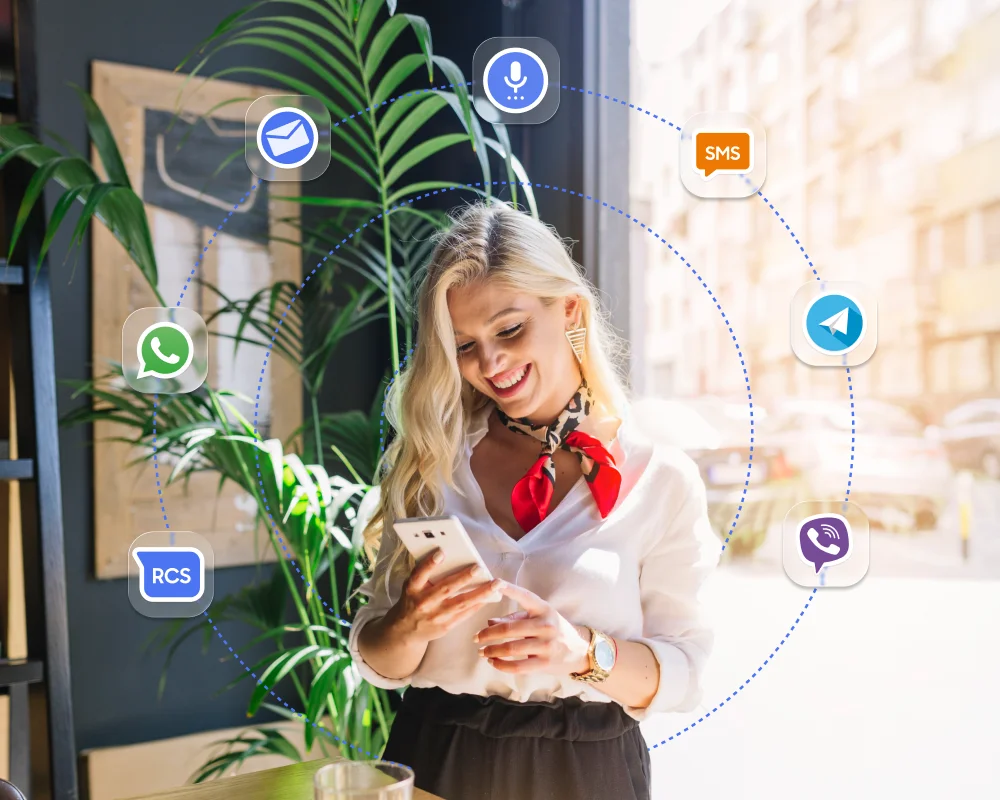
Each digital engagement channel has a natural job. SMS handles urgent alerts well, chat apps handle conversations well, and email handles long-form content well. Matching the channel to the job is often the quickest improvement you can make to engagement.
SMS for time-sensitive alerts, reminders, and promotions
SMS reaches almost any mobile phone without an app or a data connection. The channel is strongest with short, urgent content like one-time passwords and appointment reminders. Keep SMS messages brief and give each one a single clear action.
WhatsApp, Viber, and Telegram for two-way conversations
Chat apps are built for back-and-forth exchanges, which makes them a strong fit for customer service and guided sales conversations. WhatsApp is now a mainstream business channel, with 52% of the leaders in the 2026 survey already using it. Viber has a strong audience in parts of Eastern Europe and Southeast Asia, while Telegram is popular in Eastern Europe and Central Asia. With an interactive WhatsApp message, your customer can tap a button to confirm or reschedule instead of typing a reply.
RCS for rich branded messages with buttons and media
RCS (Rich Communication Services) adds branded sender profiles and rich media to the default messaging app on supported phones. Because RCS lives in the native messaging app, the customer doesn’t need to download anything. RCS works well for visual promotions and booking flows where tapping a suggested reply is easier than typing an answer.
Email for newsletters and long-form content
Email remains the best channel for content that needs space, such as newsletters and onboarding sequences. Email is less suited to urgent messages, because customers often check their inbox hours after a message arrives. Pair email with a faster channel when timing matters.
Social media and online communities
Social platforms and branded communities give customers a public place to ask questions and see how other customers use your product. Social engagement works best as a bridge into private conversations. A click-to-WhatsApp ad, for example, can turn a social media impression into a one-to-one chat you can follow up on.
Voice calls and live chat for complex issues
Some issues need a person. Billing disputes and high-value sales conversations often move faster when a customer can speak to an agent or chat with one in real time. Your strategy should make the handoff from automated messaging to a human agent easy, so the customer never has to repeat information they already gave.
Digital engagement channels at a glance
| Channel | Best for | Reach | Key capabilities |
| SMS | Urgent alerts, OTPs, reminders, flash promotions | Almost any mobile phone, no app needed | High open rates, works without data, short text |
| Customer service, order updates, conversational sales | Customers with WhatsApp, strong in many global markets | Interactive buttons, media, templates, chatbots | |
| Viber | Promotions and service in markets where Viber leads | Strong in parts of Eastern Europe and Southeast Asia | Images with action buttons, two-way chat |
| Telegram | Two-way service and community updates | Strong in Eastern Europe and Central Asia | Buttons, bots, media |
| RCS | Rich branded promotions and booking flows | Supported phones and carriers | Verified sender, carousels, suggested replies |
| Newsletters, long-form content, documents | Anyone with an email address | Rich layouts, attachments, low cost per send | |
| Social media | Discovery, community, public support | Platform users | Public reach, ads that open private chats |
| Voice and live chat | Complex or high-value issues | Any phone or web visitor | Real-time human support |
What Are the Best Practices for a Digital Engagement Strategy?
Strong engagement depends less on any single campaign than on a few habits applied consistently. The five practices below are the ones that most often separate messages customers answer from messages they ignore.
Let customers choose their preferred channel
Ask customers how they want to hear from you at signup or in your first conversation. Then store the answer in your customer record and use it. Customers who choose their channel are more likely to read and reply, and the choice also reduces opt-outs from people who felt contacted on the wrong channel.
Use two-way conversations instead of one-way broadcasts
A broadcast tells the customer something. A conversation invites the customer to act. When you send an interactive WhatsApp message with buttons such as “Confirm,” “Reschedule,” or “Talk to an agent,” the replies can flow into a chatbot or a shared agent inbox where your team can respond. Even a simple reminder becomes more useful when the customer can answer it.
Configure channel fallback to improve message deliverability
Channel fallback sends a message on a second channel when the first one doesn’t get through. If an interactive WhatsApp message is undelivered after a set period, for example, an SMS with the same key information can follow. Real-time delivery reports make fallback possible, because your CRM, AI agents, or other management systems can see the failed status and trigger the backup message automatically. Fallback matters most for time-sensitive content like OTPs and payment alerts.
Integrate messaging channels with CRM and customer data platforms
Your CRM, AI agents, or other management systems hold the intelligence about each customer. Your messaging platform delivers the response. When you connect the two through an API, a customer action can trigger the right message automatically, based on their history. A few common triggers include:
- Abandoned cart: A recovery message after a defined delay.
- Inactivity: A personalized reactivation offer after a set number of days without a visit.
- Milestone: A reward message when a customer reaches a loyalty threshold.
- Transaction: An instant confirmation after a payment, deposit, or order.
Limit message frequency and respect quiet hours
More messages rarely mean more engagement. Set a frequency cap for each segment, and watch your opt-out rate as an early signal that you have crossed the line. Schedule messages in each recipient’s local time zone, and avoid sending promotional content late at night or early in the morning. Urgent service messages, such as fraud alerts, are the main exception.
Frequently Asked Questions About Digital Engagement Strategy
What is an example of a digital engagement strategy?
A travel company might send a booking confirmation by email, a check-in reminder by SMS, and an interactive WhatsApp message that lets the traveler choose a seat or add luggage. Each message uses the channel that suits its job, and every reply is tracked in one customer record.
How do you measure digital engagement?
You can measure digital engagement through KPIs such as response rate and conversion rate, chosen to match your business goal. Opt-out rate is also worth tracking as an early warning sign.
Which channel is best for customer engagement?
No single channel is best for every message. SMS suits urgent alerts, WhatsApp and other chat apps suit two-way conversations, and email suits long-form content. The best channel is the one your customer prefers for that type of message.
How often should you message customers?
Message frequency should depend on the value of each message and the customer’s own activity. A rising opt-out rate is the clearest sign that you are sending too often.
Is SMS still effective for digital engagement?
Yes. SMS remains one of the most reliable channels for time-sensitive messages because it reaches almost any mobile phone without an app. SMS works best as one part of a broader channel mix rather than as your only channel.
Where Should You Start with Your Digital Engagement Strategy?
Start with the channels where your customers already spend their time, and add new ones based on what your data shows. Most leaders who expand their channel mix see a measurable benefit. In the 2026 State of Digital Customer Communication Survey, 86% of respondents said engagement rose after they added their most recent new channel.
MMDSmart brings the messaging channels in this guide together on one platform, with two-way chats and an API that connects to your CRM, AI agents, or other management systems. With MMDSmart MessageWhiz, you can reach each customer on the right channel, at the right time, and turn more of your messages into conversations your team can act on.
Talk to the MMDSmart MessageWhiz team about your digital engagement strategy