










Building a resilient 2027 Carrier Grade Voice and A2P Strategy
For carriers, hubs, and operators, 2027 planning is no longer only about securing the lowest termination rate.
Traffic quality expectations are rising. Enterprises want delivery visibility. Regulators and mobile operators keep tightening messaging standards, requiring SMS firewalls to CLI rules. And voice traffic is increasingly tied to cloud contact centers, SIP platforms, and real-time performance data.
That changes how you should evaluate your voice termination and A2P SMS termination partners. A resilient strategy doesn’t merely focus on ensuring capacity. It needs route accountability, CLI integrity, compliance-ready messaging infrastructure, scalable voice connectivity, and partners that understand both wholesale routing and direct enterprise traffic.
Here is a practical framework for building it.
1. Wholesale voice termination: start with route accountability
International voice termination is easy to price and difficult to guarantee. A low advertised rate means little if a route degrades, ASR and ACD drop, or the CLI is altered on the way to the destination, and no one is accountable for fixing the issues. For carriers, that creates a familiar cycle: customer complaints, traffic rerouting, margin erosion, and time lost chasing upstream providers.
When evaluating suppliers, look beyond the rate card:
- Who manages the route end-to-end?
- Is the underlying infrastructure owned and controlled by the supplier, or resold capacity?
- Is CLI guaranteed, or can it be stripped or altered downstream?
- Are routes tested daily, with ASR/ACD reporting you can see?
- Are SLAs specific enough to be operationally useful?
- Is a dedicated team available 24/7 when performance issues arise?
The commercial question for 2027 is not only “What does this route cost?”
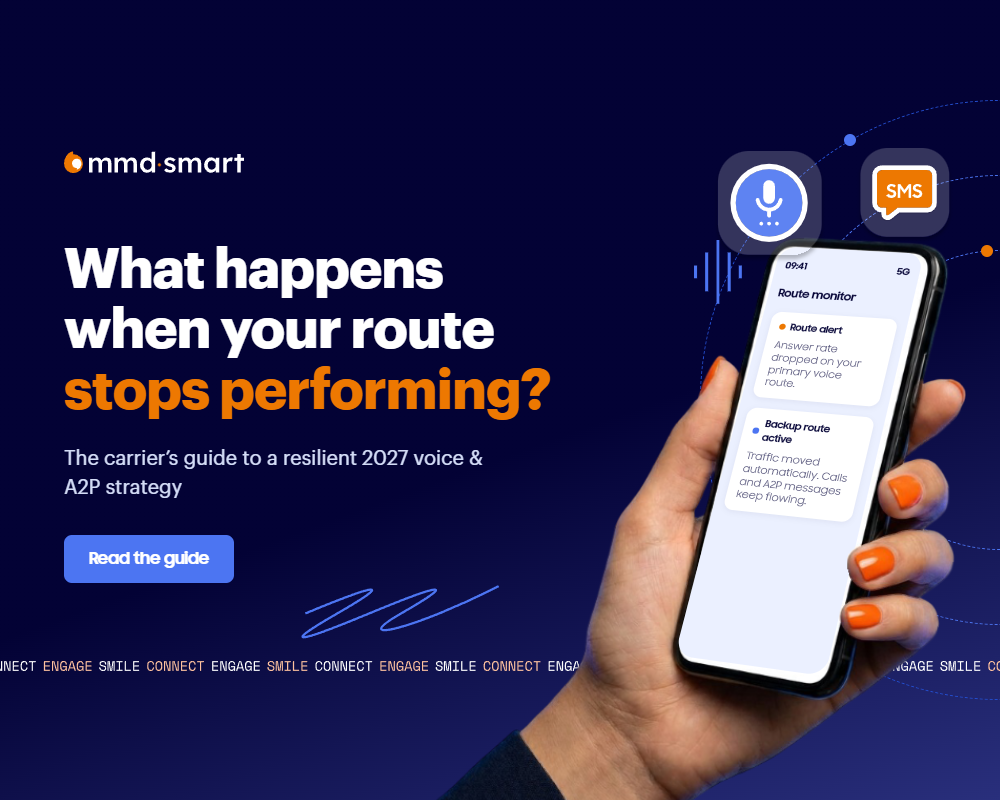
It is: “What happens when this route stops performing?”
2. A2P SMS termination: treat messaging as infrastructure
A2P messaging is business-critical for enterprises in banking, e-commerce, travel, logistics, and gaming. OTPs, transaction alerts, and delivery notifications cannot be delayed or lost. High-volume messaging therefore needs a different operating model from basic SMS connectivity.
Traffic has to be delivered reliably, kept away from grey routes, and monitored in real time to check for deliverability and performance..
A strong A2P SMS termination partner should provide:
- Direct reliable carrier connections across target markets, with no upstream intermediaries
- Grey-route protection and compliance monitoring built into the routing layer
- Anomaly detection and system tools to prevent telecom fraud such as SMS pumping and artificially inflated traffic (AIT)
- Real-time delivery reports (DLRs) per message
- Message queuing and scalable capacity, so peaks do not cause silent drops
- Pricing stability that supports traffic forecasting
Grey routes may offer a short-term price advantage, but can also result in delivery instability, firewall blocking, security vulnerabilities, and reputational risk. As enterprises expect measurable performance and operators enforce stricter standards, compliance-ready routing has become a commercial requirement.
Industry frameworks help here. Look for suppliers that are members of bodies such as the MEF and GSMA and that follow recognized A2P codes of conduct.
3. Use SMS delivery reports and voice quality data as commercial tools
Route performance data should not live only in a NOC dashboard. It should inform commercial decisions.
Real-time DLRs, ASR/ACD trends, and latency data show where traffic is performing well, where delivery quality is weakening, and where rerouting or capacity adjustments are needed.
That visibility supports better decisions on:
- Route selection and traffic steering
- Capacity planning in high-demand destinations
- Customer escalation management
- Margin protection per destination
- Quality-based commercial discussions with enterprise customers
The most valuable suppliers move your traffic and also are transparent about what is happening to it.
4. Hosted SIP trunking and virtual numbers: plan for cloud voice demand
Voice demand is changing shape. More contact centers run in the cloud, and more businesses need voice connectivity that can expand quickly without a physical build-out or long PRI lead times.
Hosted SIP trunking gives carriers and communication providers a way to serve that demand. Look for SIP that connects to any SIP-compatible PBX, dialer, or custom call-center system, with dynamic channel scaling and fast go-live.
Numbering matters too. International calls from unfamiliar numbers often go unanswered, so find a partner with access to local, national, and toll-free virtual numbers to help your customers reach people in every market. Number verification adds another layer by detecting ported or inactive numbers before traffic is sent.
For carriers, this creates opportunities beyond traditional termination:
- Support cloud contact-center platforms as they scale
- Provide local and international DIDs where customers need them
- Add capacity dynamically during seasonal peaks or campaign surges
- Combine voice connectivity with messaging and contact-center services
The planning question: can your supplier grow with your customers’ call volume, or will capacity become the next bottleneck?
5. Recognize the value of retail traffic
Wholesale carriers have traditionally focused on one side of the market: terminating traffic from other operators, hubs, and service providers.
Suppliers that also run enterprise platforms bring something extra to the relationship. MMDSmart operates MessageWhiz for business messaging and Call Center Connect for cloud contact centers, so its network carries retail enterprise A2P and voice traffic alongside its wholesale business.
For carriers, hubs, and operators, that can mean:
- Retail enterprise traffic to bid on, as well as routes to buy, opening the door to two-way deals
- Better insight into how live enterprise traffic performs
- Voice, A2P messaging, SIP, and numbers under one partner and one agreement
- Fewer vendor relationships to manage
This does not replace the need for strong wholesale economics. It adds a supplier that understands traffic from both the network side and the enterprise-customer side.
6. Your 2027 wholesale voice and A2P supplier checklist
Before locking in next year’s voice and messaging partnerships, ask each prospective supplier:
- Route ownership: Do you own and control the infrastructure behind the routes you sell?
- CLI integrity: Is CLI guaranteed on your voice routes?
- Accountability: What SLAs back your voice termination, and is 24/7 support included?
- A2P protection: How do you prevent grey-route traffic, detect fraud, and monitor compliance?
- Visibility: What real-time DLRs and voice quality reporting do you provide?
- Scalability: Can SIP capacity, DIDs, and messaging throughput scale as our customers grow?
- Coverage and consolidation: Can you support voice, messaging, SIP, and numbers across our priority destinations under one agreement?
- Enterprise insight: Do you operate enterprise platforms that generate live traffic on your own network?
[Optional CTA: Download the checklist as a PDF]
How MMDSmart answers the checklist
MMDSmart has been building carrier-grade voice and messaging since 2007. Its Telco Services are built on routes the company owns and manages end-to-end, across 190+ countries:
- Wholesale voice termination with CLI-guaranteed routes, daily route testing, SLAs, and dedicated account teams
- A2P SMS termination with direct carrier connections, no grey routes, compliance monitoring in the routing layer, real-time fraud alerts, real-time DLRs, and 99.999% uptime
- Hosted SIP trunking, virtual numbers, and number verification
- Retail enterprise traffic from MessageWhiz and Call Center Connect
- MEF and GSMA membership, and signatory of the A2P Code of Conduct
One partner, one agreement, 190+ countries.
FAQ
What is A2P SMS termination?
A2P (application-to-person) SMS termination is the delivery of messages sent by business systems, such as OTPs, alerts, and notifications, to mobile subscribers on a destination operator’s network. A termination provider carries that traffic from the sender’s platform to the operator, ideally through direct, compliant connections.
What is a grey route in SMS?
A grey route delivers A2P traffic through channels the destination operator has not authorized, for example by disguising it as person-to-person traffic or using SIM farms. It can look cheaper, but it risks blocking by SMS firewalls, unreliable delivery, and compliance and reputational damage.
Why does CLI matter in wholesale voice termination?
CLI (calling line identification) is the number shown to the person receiving the call. If a route strips or alters it, calls are more likely to be ignored or flagged, and the traffic can breach local regulations. CLI-guaranteed routes keep the original number intact end-to-end.
What are ASR and ACD?
ASR (answer-seizure ratio) is the share of call attempts that are answered. ACD (average call duration) is the average length of connected calls. Together they are the most common indicators of voice route quality.
What is the difference between hosted SIP trunking and PRI?
PRI uses physical lines with fixed channel capacity and long installation lead times. Hosted SIP trunking delivers voice over IP, so channels can be added or removed on demand and go live in days, with no new hardware.
The strategic shift for 2027
The carriers that win in 2027 will be the ones that offer more than the lowest rate in every destination:
- Reliable, CLI-guaranteed termination backed by accountable route management
- A2P messaging that is compliant, visible, and scalable
- SIP connectivity that grows with cloud contact-center demand
- A simpler commercial and operational experience across voice and messaging
- Insight drawn from live traffic, not assumptions
So alongside “Where can we terminate more traffic?”, ask:
“Where can we originate it, protect it, measure it, and grow it?”
Planning your 2027 routes? Talk to a Telco Expert at MMDSmart.