








You already know a one-time password protects an account. It’s a single-use code sent by SMS, WhatsApp or voice call to confirm someone is who they say they are. It’s especially important when it’s a family’s contact details, a child’s information, or a parent’s trust that your platform will keep their household’s data where it belongs.
Why does OTP security feel different when the data belongs to a family?
A verification code guarding a financial account has an obvious job: stop threat actors from moving money. A verification code guarding a family membership platform, a parenting app, or a household account has an additional job that’s just as important. It confirms that the person signing in is actually the parent who registered, not someone who found a way around a weak login step. The sensitive data at stake might not be payment information, but could be a child’s name, a home address, or the pattern of a family’s daily life.
What happens when an OTP verification code fails?
What does OTP verification failure mean? If a code arrives late, or doesn’t arrive at all, a customer trying to register or log in assumes the platform is not working properly and can abandon sign up or other intended engagement with the vendor. That assumption forms fast, and it’s hard to undo. Industry data from AWS and Vonage shows that standard SMS OTP verification flows achieve only about an 80% completion rate, meaning 1 in 5 users drop off right at the verification step.
In fact, consumer research by Prove Identity reveals that 60% of consumers abandon account creation if verification takes longer than 40 seconds, and 51% will switch to a competitor over slow identity checks. For a membership platform where every new relationship starts with that first sign-up, a failed or delayed OTP doesn’t just disrupt registration—it can end the customer relationship before it even begins.
For a membership platform where every new relationship starts with that first sign-up, a failed OTP at registration can end the relationship before it begins.
How does intelligent OTP message routing keep every registration secure?
The fix isn’t just sending the code. It’s making sure the code is routed in the fastest, most reliable path to the recipient’s device, on the right carrier network, every time.
MMDSmart MessageWhiz OTP service and Communications as a Service (CPaaS) platform not only owns its switches but also applies AI-powered routing that evaluates network conditions in real time and selects the optimal path for each individual message rather than relying on one fixed route. Whether the request comes from your registration flow, your login screen, or another account-based touchpoint, the code can reach the customer on time, on the first try.
How FamilyPass Saw an Increase in Sign Ups After Implementing MessageWhiz OTP
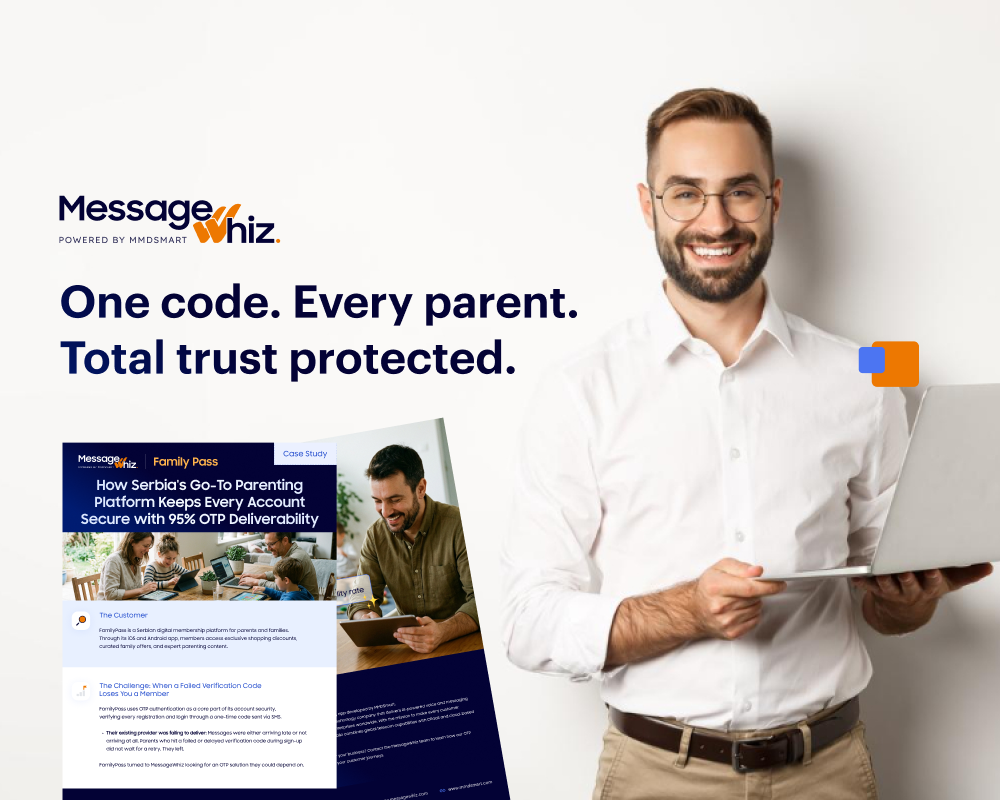
FamilyPass, a membership platform serving parents with shopping discounts, family offers, and parenting content, uses OTP authentication to verify every registration and login. Their previous provider left codes arriving late or not at all, and parents who hit that failure didn’t stick around for a retry.
After integrating MMDSmart MessageWhiz, FamilyPass reached a 95% OTP deliverability rate across all authentication traffic.
Fewer failed codes reduced customers from dropping off during sign-up and lowered the number of members locked out of accounts they already trusted with their family’s information.
If your platform is asking parents, or any customer, to hand over sensitive account data, the verification step that comes first can’t be the weak point.
Download the FamilyPass case study to see how dependable OTP delivery helped one family platform earn that trust from the very first sign-up.
Download the FamilyPass Case Study
FAQ
What makes OTP verification important for platforms for handling sensitive data?
An OTP confirms that the person signing in is actually who they say they are, which matters for any customer account. In the case of a family membership platform, the account holds a child’s name, a home address, or other details a family expects to stay private. The verification step isn’t just a login formality. It’s often the first proof a parent gets that your platform takes their data seriously.
How does a failed verification code affect user trust during registration?
A customer who hits a delayed or missing code during sign-up tends to assume the platform can’t be trusted with anything more sensitive down the line. That impression forms quickly, and it can end the relationship before it starts, since registration is usually the first interaction someone has with your service.
Why do families expect a higher standard of security than the average user?
Parents are protecting more than their own information. Every account tied to a child adds a layer of caution that shows up as lower tolerance for friction or failure at sign-up. A platform that treats verification as an afterthought risks losing that trust before a relationship even begins.
What should a business look for in an OTP delivery provider?
You want a provider that can guarantee fast, reliable, secure delivery across carriers and regions. The gap between when a code is sent and when it actually reaches a device is where most verification failures happen, so delivery speed matters. Additionally, when delays cause customers to click resend code, it increases the cost of the message.
Can slow OTP delivery hurt customer retention beyond the first sign-up?
Yes. A parent or customer who experiences one failed or delayed code may hesitate to trust future logins, even after the issue is resolved. Retention depends on consistent reliability, not a single good experience, since account access is something customers return to repeatedly.
How does routing intelligence reduce OTP delivery failures?
Routing intelligence evaluates real-time network conditions and selects the fastest, most reliable path for each message instead of relying on a single fixed route. This matters because a message can be sent instantly and still stall on its way to the recipient’s carrier, which is often where delivery breaks down.
What industries rely heavily on dependable OTP verification?
Any business handling sensitive, financial, personal or family data, including membership platforms, parenting apps, healthcare portals, and financial services, depends on OTP reliability to protect that trust. In each case, the account being protected represents more than a login. It represents a relationship the customer expects you to safeguard.